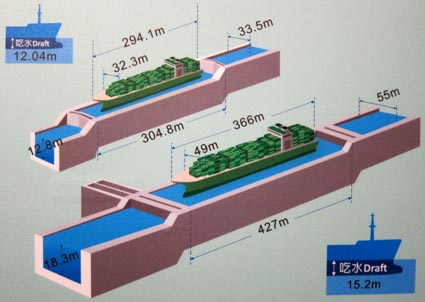
運河拡張プロジェクトは2007年に始まり、2016年6月に9年を費やして完成した。新閘門を通航できる船舶の大きさの上限は、
長さ366メートル、幅49メートル、喫水15.2メートルである。新しい運河閘室は、コンテナ船について言えば、20フィートコンテナ積載
換算で14,000個のコンテナを積載する船舶をも通航させることができる。
従前の運河では通航できる船舶のタイプとサイズに制約があった。閘室の制約上から、長さ294.13メートル超、幅32.3メートル超の
船は通航できなかった。また、熱帯淡水満載吃水線は12.04メートルを超えることができなかった。この最大限界ぎりぎりの船は
「パナマックス船」と呼ばれた。そして、この限界を超える船は「ポストパナマックス船」と呼ばれていた。
新閘室が完成した現在では、全長366メートル、幅49メートル、喫水15.2メートルの最大限界ぎりぎりのコンテナ船は「ネオ・パナマックス船」
と呼ばれる。
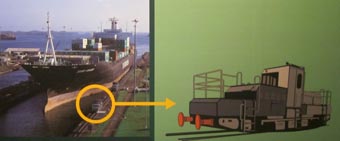
従前の閘門で船舶を通航させる補助手段としてウォータートラクター (water tractors) が用いられたが、新閘門ではタグボートが
用いられる。なお、展示のジオラマ模型には以下のような説明が付されている。
The Panama Canal, an achievement that shaped the history of water transportation.
The Panama Canal cuts across the Isthmus of Panama to connect the Atlantic Ocean to the Pacific Ocean.
Often referred to as the "World's Bridge", the Panama Canal makes it unnecessary for ships traveling
between these two great oceans to sail all the way around South America. The Panama Canal is now the busiest canal
in the world, and every year, approximately 12,000 ships pass through.
1880: The Birth of the Panama Canal
France poured energy into original construction of the Panama Canal. They applied their previous experience building
the Suez Canal, but Panama posed very different problems because of its tropical-jungle environment.
Diseases such as the yellow fever and malaria compromised construction and eventually forced France
to abandon the partly finished canal.
1914: The U.S. takes over the construction of the Panama Canal
By the early 20th century the United States had emerged as a prosperous world power, and its influence in South America soon
extended to the Panama Canal. The US acquired a permanent lease on the canal zone and took over construction in 1904.
First, they undertook a task to improve sanitary conditions there. Then, with the idea of "water staircases," they started
to build the Panama Canal in 1904 and completed it in 1914.
2016: The Expansion of the Panama Canal is completed in 2016.
The Panama Canal Expansion Project began since 2007, which had been constructed for nine years, and
was completed in June, 2016. The expanded Panama Canal lock chambers are capable of allowing vessels
which are 366 meters in length, 49 meters in width, and water draft 15.2 meters to pass through. As for container ships,
the largest capacity is having 14,000 20-feet-equivalent (TEU) containers on the vessel to pass through the new
canal lock chambers.
Due to its narrow channel in the past, there were certain restrictions on the type and size of the ships
transiting the Panama Canal. Generally speaking, the length should not exceed 294.13 meters, the width should not
exceed 32.3 meters, and the tropical fresh water draught should be about 12.04 meters; this kind of ships
is called the Panamax ship. Ships larger than this standard are called Post-Panamax ships.
Within the limits (Length 366 meters; width 49 meters; and draught 15.2 meters) of the new water locks
in Panama Canal, the largest container ships that could go through are called the "Neo Panamax".
The original Panama Canal water locks have to use water tractors to assist vessels to go through.
The new water locks, on the other hand, use tug boats to operate this mission.
The Panama Canal is a vital waterway connecting the Pacific and the Atlantic Ocean. However, the two ocean surfaces
are not on the same level which caused ships difficult to pass through. Therefore, the engineers designed a system called 'water staircase' to allow ships to cross the Isthmus of Panama safely.
The water staircase consists of gigantic water gates 'locks' with different heights. When the gate closed,
the water flowed to lower lock to make the water surface even allowing ships to go through, which seems like climbing
the stairs.
Current Locks: The capacity of the older water lock chambers can allow 4,400 TEU container ships to pass through.
New Locks: The capacity of the new water lock chambers can allow 14,000 TEU container ships to pass through.
Materials by The Panama Canal Authority
 Back to: Top Page |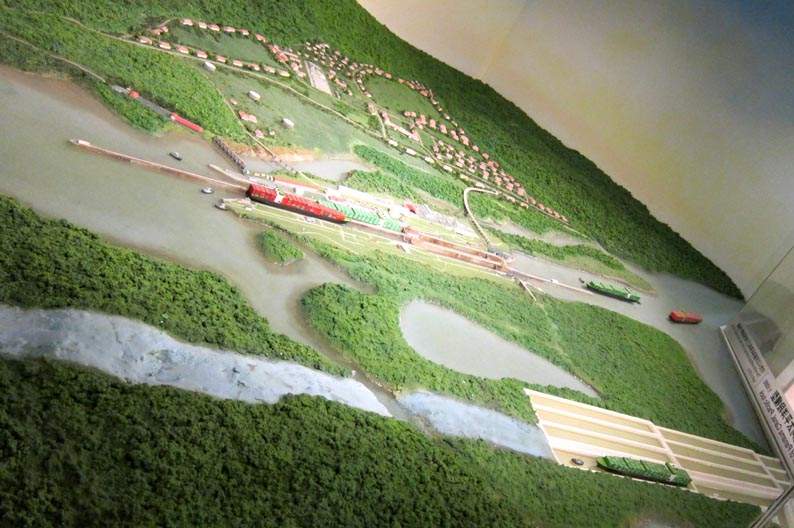

 4
4